Shopping Cart
There are no more items in your cart


Is 40 too late to learn to surf? Age, lessons and tips


Whether you are wondering if 40 is too late to learn to surf or simply deciding whether now is the right moment, this article gives you a clear, honest picture of what readiness involves, which equipment to choose, how quickly you may progress and how to stay safe from your first lesson onwards.
Is 40 too late to learn to surf?
The short answer is no. Coaching centres around the world regularly welcome first-timers in their 40s, 50s and 60s, and one recorded its oldest guest at 78. Adults over 40 represent a meaningful share of new surf-school students worldwide; one established surf camp reports an average guest age of 39. Learning to surf at 40 is common, not exceptional.
Why age is not the barrier
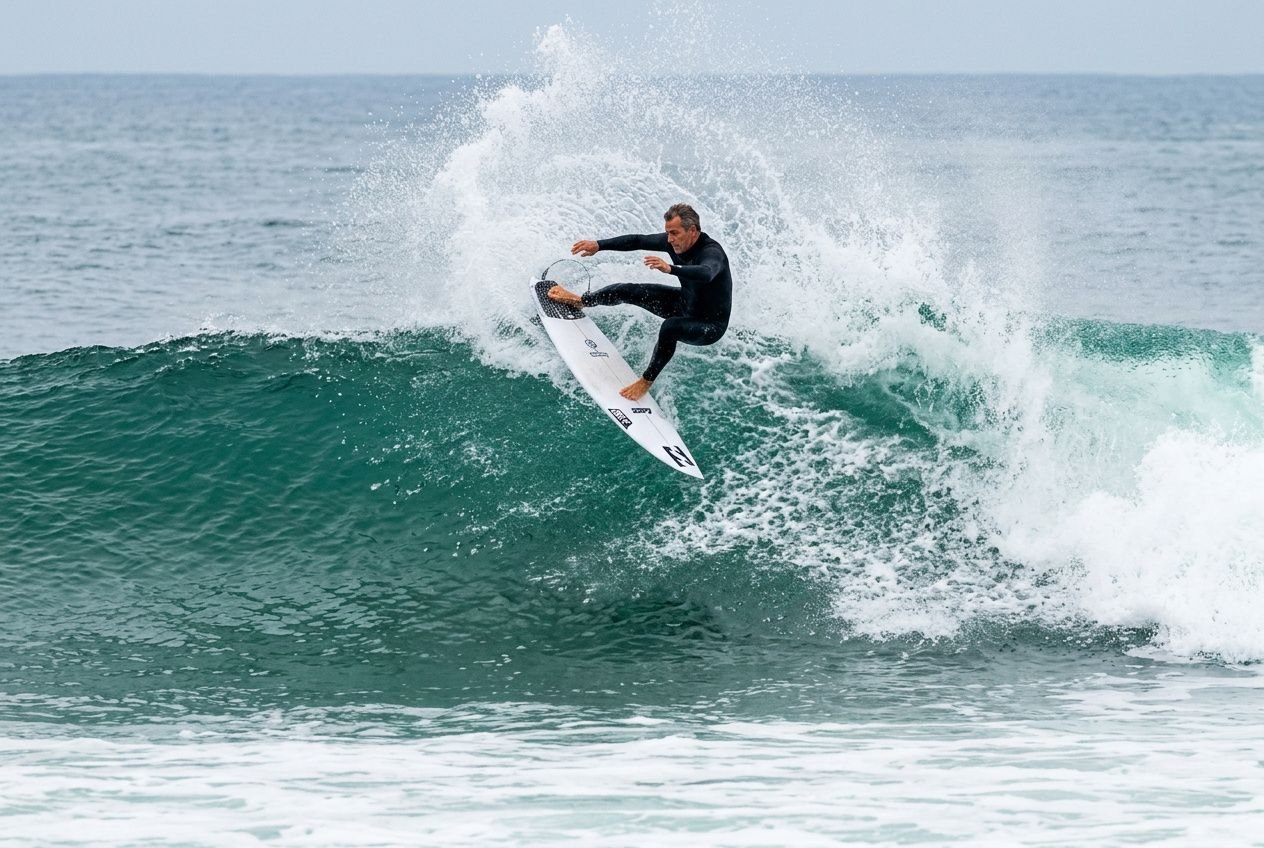
Surfing is a timing sport with a paddling demand, not a pure strength sport. That difference matters: youth and raw athleticism are not prerequisites. Around 95% of adult first-timers stand up during their first coached session, regardless of age, which should settle doubts about whether 40 is too late to learn to surf at a meaningful level. Physical condition counts far more than the number on your passport.
The real entry requirements are simple: confidence in chest-deep water and the ability to stay calm after a fall. If you can swim briskly for 15 minutes without stopping and remain active in daily life, you are ready for a beginner lesson. Coaching-centre data confirms the same picture: the average beginner is now 39.
What readiness really means
Readiness is not about being the fittest version of yourself. It comes down to two practical thresholds: swimming competence and composure after a wipeout. A surf instructor can work with almost any mobile adult who meets both. The main problems that can delay a first lesson are an inability to swim confidently and an unmanageable fear of being tumbled by the water; both can be addressed before you step on a board.
One common trap is deciding in advance that you will be bad, or comparing yourself with younger students in your group. Fear of public failure can create a psychological ceiling that age never would. The right choice when doubt creeps in is to focus on your own session, wave and pop-up. Mundo-Surf stocks a full range of beginner equipment, including the NSP P2 Soft Surf board, paired with a reliable Mundo‑Surf basic leash from your first session.
Prepare your body for surfing
Surfing fitness is not built overnight, but it does not require a radical lifestyle overhaul. A focused 4–6 week preparation period can accelerate your early progress, reducing the soreness and frustration that hold many beginners back.
Fitness before your first lesson
When you are learning to surf, the pop-up often catches adults off guard. It is a controlled squat under load, demanding hip, ankle and shoulder mobility rather than brute strength. Work on those ranges of motion in the weeks before your first session, then focus on these areas:
- Swimming laps: build paddle endurance with regular pool sessions, aiming for 15 unbroken minutes of brisk freestyle before your first lesson.
- Hip and shoulder mobility: daily yoga or dynamic stretching improves your pop-up range of motion, targeting the joints that sedentary habits tend to tighten.
- Core exercises: planks, hollow holds and rotational work build the stability needed to stay balanced while riding waves.
- Push-up progressions: gradually increasing your push-up volume develops the pressing strength needed to push off the board cleanly during pop-up drills.
Perfect preparation is not a prerequisite for your first lesson. Consistent sessions and a sense of humour matter more than an intensive pre-trip routine. Start now and adjust as you go.
Mobility, swimming and recovery
Open-water swimming is useful for composure as well as conditioning. Becoming familiar with small-wave turbulence before your first surf lesson can reduce the panic reflex after a wipeout. By contrast, pool swimming develops cardiovascular capacity through water resistance. It supports circulation, stamina and oxygen delivery for surf fitness on the water. A 2019 study found that regular ocean-based sports significantly improved balance, functional strength and psychological well-being in adults over 50, with benefits continuing across sessions.
Adults over 40 generally need more recovery time between sessions than younger surfers. Muscle soreness and joint fatigue last longer. Ignoring that reality can slow progress. Build rest days into your plan. On those days, surfskating offers a land-based way to reinforce surfing movement patterns and muscle memory without adding the same physical load. Yoga and light mobility work can also preserve range of motion without stressing fatigued tissue.
Choose the right board as a beginner
Equipment can quietly hold an adult beginner back before the first session even starts. Your board affects how quickly you learn, how easily you catch waves and how forgiving the experience feels when your timing is slightly late.
Why volume matters most
Board volume is the main consideration for an older beginner. A larger, thicker soft-top floats higher, catches waves earlier and forgives technical errors that would stop a smaller board dead. Many adults struggle because they are using a board that does not suit their weight or ability, not because of their age. On the water, that matters.
- More float: higher volume keeps the board, and you, higher in the water. That reduces the energy needed for paddling and makes catching waves more consistent from the start.
- Earlier wave entry: a wider, thicker outline creates speed sooner, helping you reach the wave's momentum before it passes beneath you.
- Mistake tolerance: a stable platform is less likely to punish a slightly off-centre stance, giving you room to build the muscle memory for a reliable pop-up.
- Soft-top safety: foam construction reduces the impact of board contact during wipeouts, which is useful protection during the frequent falls of your early sessions.
From 50 onwards, volume becomes even more important. On a correctly sized foam board, many learners in their 50s progress as quickly as younger students. Use a board that is even slightly too small and paddling becomes laboured, wave-catching becomes unreliable and confidence starts to fade. Ask a lesson provider about sizing before you book instead of assuming that any standard adult board will work.
Board sizes by body weight
The difference comes down to matching length and volume to your body weight. An 8–10 foot foam soft-top longboard provides the float, paddle speed and stability needed for steady progress. Stay on it until you have completed approximately 20–30 sessions with consistent pop-ups and rides on unbroken green waves; moving to a shortboard too soon can undo much of that progress.
From 60 onwards, shoulder endurance is often the limiting factor rather than balance or nerve. High-volume boards and shorter sessions are a sensible adaptation that keeps training productive over the weeks and months. Worth knowing before you buy: hiring foam boards first lets you check which dimensions suit your body before committing to a personal hard board.
| Body weight | Recommended soft-top length | Key benefit |
| Under 70 kg | 7'6" – 8'0" | Manoeuvrable with sufficient volume for early wave-catching |
| 70 – 85 kg | 8'0" – 9'0" | Stable platform balancing float and paddle speed |
| Over 85 kg | 9'0" – 10'0" | Maximum float and forgiveness during high-mistake-rate early sessions |
These ranges are a starting point, not a ceiling. Beginner surfers using correctly sized boards often build confidence faster and avoid early plateaus. A surf coach or experienced shop team can refine the choice once they know your swimming background and fitness level. Mundo-Surf's expert team can help before you place an order, with 100-day returns and free shipping on orders over £99 supporting that decision.
Recommended products
What progress looks like in surfing
A clear, realistic picture of what your first sessions, weeks and months can deliver helps prevent the discouragement that makes people quit too soon.
First lessons and early wins
Most adults catch their first wave during the opening lesson, while consistent standing in white water typically develops over a focused weekend of coaching. If you have searched online to ask whether 40 is too late to learn to surf, you will find overwhelmingly positive accounts on Reddit from adults who started surfing in their 40s.
Early progress varies without revealing your long-term potential. For some, that first ride comes within hours; for others, it takes two or three days of steady practice. Sporty students with board-sport experience often stand during their first two sessions, while less sporty beginners typically achieve a consistent stand-up by the end of their first course week.
- First session: catching white-water waves with assistance, making the first attempts at standing, and achieving at least a brief ride for most adult beginners.
- First weekend: consistent pop-ups in white water, with the first attempts to choose waves rather than relying entirely on the surf instructor to push.
- First week: stable riding in broken water, an introduction to paddling technique for unbroken waves, and early green-wave attempts for fitter or more experienced students.
- Second week: once strong paddling technique is established, catching unbroken green waves becomes achievable for a growing proportion of learners.
Small-group surf coaching, ideally with no more than eight people, gives adult learners the individual feedback that large school sessions cannot provide. Video analysis is particularly valuable here: seeing exactly what your body does during a pop-up allows targeted corrections instead of repeated guesswork. In practice, one well-structured lesson with a skilled surf coach and video review can accelerate progress more than several uncoached sessions.
From white water to green waves
Moving from broken white water to unbroken green waves is where the biggest shift happens, and it usually takes a few surf trips rather than a few sessions. Wave-reading, paddle timing and board positioning converge at this point, so quality surf coaching can make a sharp difference. Having a surf coach assess conditions alongside you may compress years of trial and error into weeks. Athletic beginners with board-sport backgrounds may reach clean green waves after approximately 10–20 days of regular surfing; others build towards that stage over a longer period without losing enjoyment.
Consistency beats fast comparisons
Surfing once a year generally preserves your current level. Two years after learning to surf, some surfers who began in their 40s are still riding white water rather than heading out the back, yet remain confident, improve steadily and enjoy every session. Learning to surf as an adult rewards patience and repetition more than isolated bursts of intensity.
That longer view also protects motivation when visible progress slows. Comparing your second month with another student’s tenth month quickly creates a false sense of failure. Measure your progress against your own last session, and you give yourself a mindset that keeps adult learners returning to the water year after year while developing durable surfing over 40.
Surfing safely with the right support
Safety in surfing comes from making informed decisions before, during and after every session. For an adult starting surfing at 40, good habits established from the first lesson can shape the decades ahead. Get the basics right early: the ocean rewards a methodical approach far more than bravado.
Safer conditions for every surfer
Choosing the right break and conditions is the most effective safety decision an adult beginner can make. Sandy-bottomed beginner breaks with small, consistent waves reduce avoidable hazards, leaving you free to focus on technique instead of managing an unpredictable environment. Build on that with three habits that are then non-negotiable:
- Leash and warm-up: attach your leash before entering the water, then warm up for around 10 minutes to prepare your joints and connective tissue for paddling and popping up.
- Know your limits: stop before exhaustion affects your form and judgement. Tired surfers make avoidable errors that can lead to contact with the board or seabed.
- Rip-current escape: swim parallel to the shoreline to leave a rip current rather than fighting directly against it. Understand this before paddling out.
The chicken-wing pop-up is a common technical problem with a physical cost. Pressing the inner edges of both knees firmly against the board during the stand-up can cause rashes and bruising after roughly an hour of practice. A surf instructor can correct the movement early, which helps explain why coached lessons in a surf camp or surf retreat often provide better safety and efficiency than learning alone.
Lessons that build confidence
Personalised instruction from coaches experienced with adult learners is usually more effective than a large group lesson at a generic surf school. A qualified surf instructor can choose suitable conditions, read waves with you and adapt technique cues to your movement patterns. The difference comes down to individual guidance, particularly for adults over 40, whose progress often depends on precise feedback.
A full surf camp week or dedicated surf retreat provides consecutive-day practice that occasional single lessons cannot replicate. Small groups of no more than eight people, beginner-appropriate boards and video analysis reinforce that effect. A surf trip organised in this way can achieve in one week what intermittent lessons may take months to reach.
Surfskating between water sessions is an effective land-based way to maintain and develop surfing movement. The balance demands and rotational mechanics of a surfskate transfer directly to wave riding, reinforcing muscle memory without the physical load of paddling. Many surf coaches recommend it for adult learners who want to maintain momentum between surf trips rather than returning to the starting point each time they reach the water.
Benefits beyond the waves
Surfing provides a demanding cardiovascular workout. Water resistance makes every paddle stroke work harder than equivalent land-based movement, improving heart health, blood circulation and stamina over time. A 2019 study confirmed that regular ocean-based sports improved balance, functional strength and psychological well-being in adults over 50, with those benefits continuing to accumulate across sessions rather than plateauing early.
Beyond the physical effects, surfing can relieve stress because concentrated attention on wave selection, timing and board control leaves little room for daily worries. Starting surfing at 40 gives you potentially decades to develop those benefits, along with a growing skill set and stronger confidence.
Frequently asked questions
Is it a good idea to learn to surf at 40?
Learning to surf at 40 is a good choice for most active adults. Coaching centres worldwide regularly teach beginners in their 40s, 50s and 60s, and around 95% of adult first-timers stand up during their opening coached session, whatever their age. The real prerequisites are swimming confidence in chest-deep water and composure after a fall; neither depends on age. Surfing is low-impact, builds cardiovascular fitness, core strength and balance.
How long does it take to learn to surf as an adult beginner?
Most adult beginners stand up in white water during their first lesson and ride consistently after a focused weekend of coaching. Moving from broken white water to unbroken green waves usually takes several trips rather than a few sessions, often over several weeks of regular practice during a surf trip or surf retreat. Athletic beginners with board-sport experience may reach clean green waves after approximately 10–20 days of surfing. Consistency makes the difference: surfing once a year tends to preserve the same level, while regular sessions build lasting progression in your surfing skills.
What board should a 40-year-old beginner use?
Start with an 8–10-foot foam soft-top longboard suited to your body weight: under 70 kg suits a 7'6"–8'0" board, 70–85 kg suits an 8'0"–9'0" board, and over 85 kg suits a 9'0"–10'0" board. Board volume is the key factor for an adult beginner. A larger, thicker soft-top floats higher. It catches waves earlier. It forgives timing mistakes that would stop a smaller board. Do not move to a shortboard before completing roughly 20–30 sessions with consistent pop-ups and green-wave riding. Hire before you buy so you can confirm which dimensions work for your body.
Share this article: