Shopping Cart
There are no more items in your cart


How to measure surfboard volume calculator guide


How to measure surfboard volume with a calculator
Volume is the number that clarifies board choice fast. It tells you how much float and paddle support you get in litres before you ever surf the board.
Once that’s clear, the next step is simple: take accurate surfboard dimensions, run the volume calculation, then compare the result with real-world specs. In practice, that gives you a more reliable path to the ideal surfboard than judging a shape by eye alone.

What measurements do you need to calculate surfboard volume?
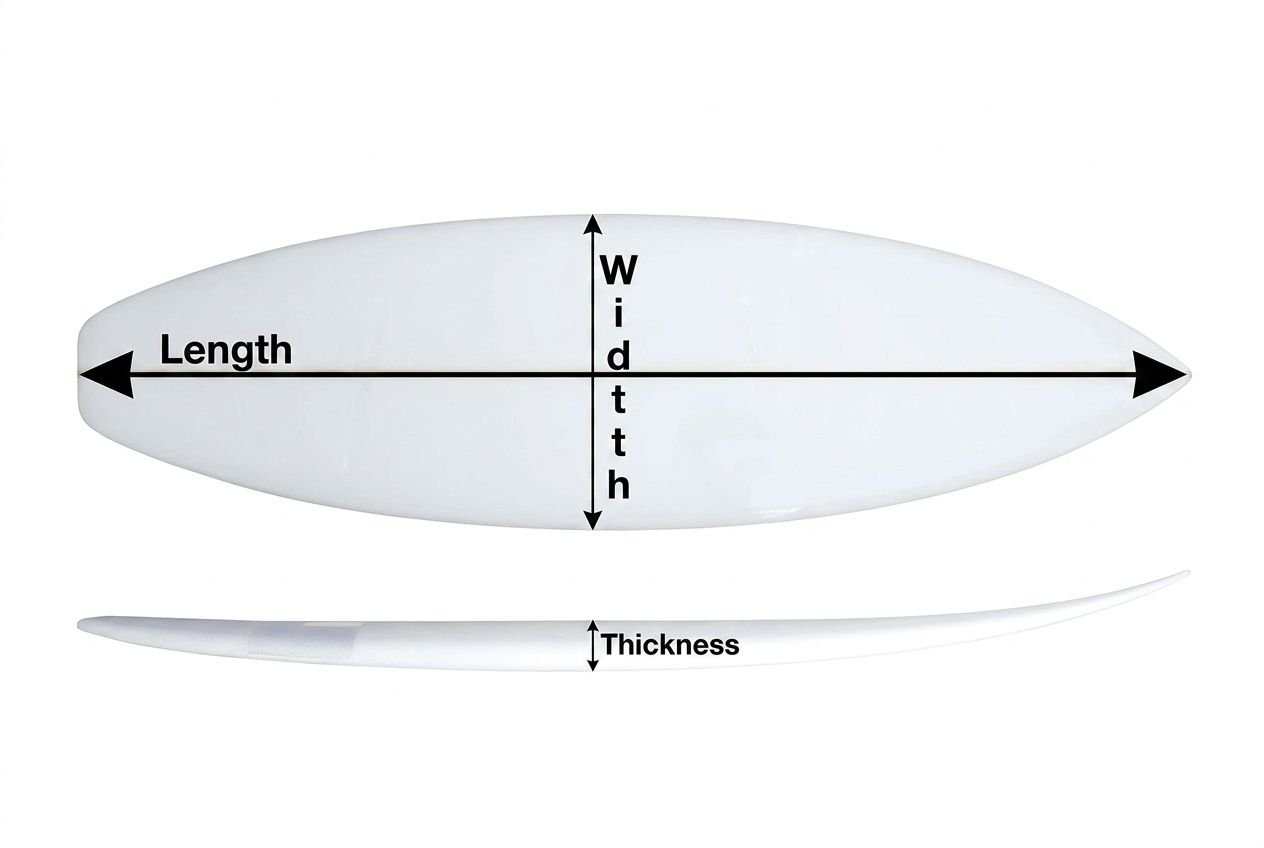
Three measurements drive everything: length from nose to tail along the centreline, width at the widest point, and thickness through the centre. Those are the inputs any surfboard dimensions calculator or surfboard volume calculator slider needs to calculate surfboard volume.
If you are wondering how to measure surfboard, accuracy matters more than speed. A few millimetres lost on width or thickness can shift the result by a full litre or more.
How to calculate surfboard volume from dimensions in inches
When asking how to calculate surfboard volume from dimensions, you can work in centimetres or inches. A surfboard dimensions calculator usually uses centimetres, so multiply each figure by 2.54 first if your tape is imperial.
The formula is direct: Length × Width × Thickness × shape factor ÷ 1000. That gives surfboard volume in litres; if you prefer how to measure surfboard volume in inches, multiply the dimensions in inches, then divide the cubic-inch result by 61.0237 to get litres.
- Convert to centimetres Multiply each inch value by 2.54 before the volume calculation. Skip that step and the result can be off by several litres.
- Apply the correct shape factor Your board type sets the multiplier: Fish (0.53), Shortboard (0.55), Hybrid (0.57), Funboard (0.59), Longboard (0.61). The difference comes down to board shape, rails, outline, and foam distribution.
- Divide by 1000 After multiplying the three surfboard dimensions by the shape factor, divide by 1000 to convert cubic centimetres into litres.
- Cross-check with manufacturer specs A calculated figure is usually within about 5%. The surfboard volume guide from the shaper remains the more precise reference.
A concrete example helps. The Tahe Paint Super Magnum is listed at 61 litres in 7'0''and 98 litres in 8'0'': a 37-litre gain from one extra foot of length, which shows why clean measurements matter when you calculate the volume.
| Board type | Shape factor | Typical volume range (litres) |
| Shortboard | 0.55 | 22–35 L |
| Fish | 0.53 | 25–45 L |
| Hybrid | 0.57 | 35–50 L |
| Funboard | 0.59 | 40–60 L |
| Longboard | 0.61 | 60–100 L |
Treat it as a surfboard volume chart for each board type, not as a fixed rule, because the same litres can feel very different depending on rocker, outline, and foil.
How to use the surfboard volume calculator slider tool
Once you have the measurements, the tool is straightforward. The surfboard volume calculator slider works both ways: enter custom measurements to calculate the volume, or start from a known number and compare it with your current setup.
To use the Custom option, input length, width, and thickness from your board or target shape. That is the right choice when you want a fast estimate from raw surfboard dimensions without waiting for a published spec.
By contrast, if you already know the board volume, you can use the tool to compare that number against your Guild Factor and skill level. It is a useful way to find your ideal volume before changing board type or moving into a more demanding board shape.
Mundo-Surf lists custom dimension options across its range; for step-up boards, choose a size around 2 to 8 inches longer than your regular shortboard and add at least 1/8 inch in thickness to handle bigger surf.
How skill level and weight refine your ideal surfboard volume
The Guild Factor system keeps it clean: body weight in kilograms × GF ratio = recommended volume in litres. If you want to find your ideal volume with structure, pair that result with a volume guide or surfboard volume chart sorted by skill level.
Typical ranges are clear enough: advanced surfers often sit around GF 0.34 to 0.36, while beginners usually need 0.40 to 0.50. Worth knowing before you buy: fitness, weak waves, cold water, or a thick wetsuit all push the ideal number upward.
Too little foam and you miss waves. Too much and the board starts to feel slower rail to rail; on the water, that matters.
Once your target is clear, compare real models rather than chasing theory alone. The mid length surfboards section at Mundo-Surf is a useful place to check measurements, published board volume, and surfboard volume in litres across different outlines.
Frequently asked questions
What is the ideal surfboard volume for my height and weight?
To find the right surfboard volume, start with your body weight in kilograms and apply a Guild Factor ratio. For a beginner at 70 kg, that usually means about 70 litres: a GF close to 1.0 gives you the flotation and paddling support you need. As your surfing sharpens, the same rider may drop to 24–25 litres, because the difference comes down to control, fitness, wave quality, and shape.
Building on that baseline, height and weight both matter, but they never work alone. Board volume and the way that volume is distributed through the shape can shift the right figure higher or lower than the first estimate. A surfboard volume chart helps you check whether standard dimensions line up with your target before you order from Mundo-Surf.
How does skill level affect calculating surfboard volume?
When calculating surfboard volume, beginners usually need volume close to body weight in litres: the extra foam keeps paddling accessible and forgives small errors. Once you move into intermediate territory, the ideal volume starts to come down, and a surfboard volume guide makes that shift easier to judge.
As soon as you lower volume, performance changes with it: less foam means more responsiveness, but also less margin for error. A volume chart based on GF ratio links surfboard size to what you can expect on the water, and on the water, that matters. The same logic applies to board type, since longboard volume often sits between 60 and 100 litres, while performance shortboards often sit below 35 litres.
Can I use a surfboard volume calculator to find the perfect volume for an unfamiliar board?
Yes, a surfboard volume calculator is a useful tool when you do not know a board well. Enter the key measurements from the surfboard dimensions: length, width, and thickness, then match the board shape and board type to the right shape factor. In practice, a volume calculator gives you a result that is usually within about 5% of the manufacturer figure, which is accurate enough for comparing options across different models.
Once you have that estimate, use a surfboard volume chart to check whether it fits your level, your waves, and your target. Worth knowing before you buy: manufacturer figures remain the most precise reference, so confirm them directly with Mundo-Surf whenever available.
Share this article: