Shopping Cart
There are no more items in your cart


How do I know what surfboard is right for me?


Figuring out which surfboard is right for you starts with the same three things every time: your body, your skill level, and the waves you actually surf, get those lined up and the choice becomes straightforward. This guide gives you a clear path, from volume and buoyancy to surfboard type and progress.
How to find the right surfboard for your level
Your weight, height, fitness, how often you surf, and your usual wave type all point towards a sensible surfboard size range. Worth knowing before you buy: brand and price come second, skill level decides whether you need a high-volume surfboard for stability or a tighter shape built for performance.
Once that base is clear, the difference comes down to matching dimensions to your real needs on the water. Use the surfboard selection guide at Mundo-Surf to compare your profile against its stock and range.
Key personal factors that shape your choice
That base makes skill level the key filter. It decides whether you need a high-volume surfboard for easier paddling and stability, or a tighter shape built more for performance.
Building on that, a guided quiz can help because it combines ability, weight, height, session frequency, and wave type in one pass. In practice, that gives you a shortlist instead of a guess.
- Skill level: An honest read of where you are protects your progress. A beginner usually benefits from more buoyancy, more stability, and a more forgiving surfboard type.
- Weight and height: These set your baseline target for surfboard volume and minimum board length. Taller or heavier surfers usually need more litres and a bigger platform to keep paddling efficient.
- Surfing frequency: If you surf once a week, adding around 20% to your baseline volume often makes sense. If you surf four or more times a week, your paddling fitness usually covers that adjustment.
- Surfing goals: Cruising, wave count, and comfort do not point to the same board as tighter turning and higher performance. The right choice when fast progress matters is not always the same as when you want pure ease.
That foundation also explains why two surfers with the same build can need different boards. A slow beach break often asks for more buoyancy, while a steeper, punchier wave type can suit a more compact shape.
Using a quiz or calculator to narrow it down
A surfboard size calculator is useful because it gives you a realistic starting point in litres. Use the surfboard volume calculator at Mundo-Surf to estimate surfboard volume from your body stats and compare it with manufacturer figures.
As soon as you have that number, compare it within the surfboard type you want to ride. At beginner stage, even a three-litre change can alter paddling, take-off ease, and overall stability.
Once you reach that stage, rental sessions or demo days show whether the surfboard size on paper translates into the right feel on the water. On the water, that matters.
Why wave conditions influence board selection
Wave type changes everything. Small, slower surf usually suits more board length and a fuller outline, while steeper, more powerful waves often suit a shorter, more reactive shape with a different performance focus.
Building on that, local conditions should guide your final call on surfboard size and surfboard type. Check the beginner surfboard guide at Mundo-Surf for recommendations matched to level and conditions.
Cold water changes the feel as well. A thicker wetsuit can affect how a board sits and how efficiently you move, so you may need slightly more volume than your baseline to keep the same paddling rhythm and stability.
What length surfboard do you actually need
Board length sets the tone from the first paddle out. It affects paddling, buoyancy, stability and how easily you catch waves, with longer boards planing earlier and feeling more stable, while shorter ones trade foam for manoeuvrability and demand a higher skill level.
Height and weight guidelines for board length
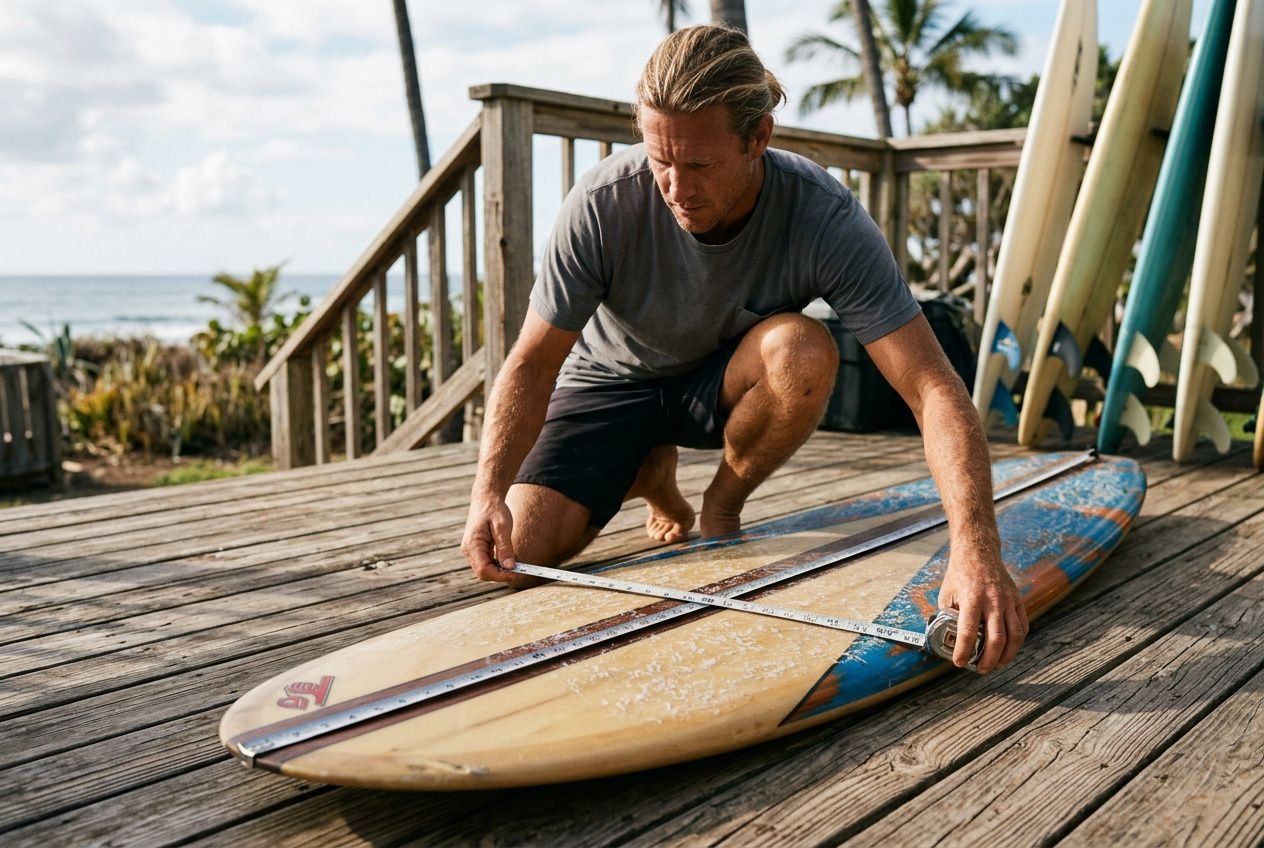
Understanding what length surfboard you need usually starts with a simple benchmark: go roughly three feet longer than your height. For a surfer standing 5'8"–6'0", that points to an 8'6"–9'0" board, with extra length if your weight or fitness calls for more support in paddling.
- Up to 75 kg: a board in the 7'0"–7'6" range with 50–60 litres gives a beginner enough float without feeling cumbersome.
- 75–85 kg: the 7'6"–8'0" range with 60–75 litres balances buoyancy with ease of carrying.
- Above 85 kg: start at 8'0" and above with 75+ litres. If conditioning is limited, more foam makes a real difference: aim for at least 90 litres to stay on plane without burning out before the set arrives.
- Intermediate surfers: can step down towards boards closer to their height, gaining manoeuvrability while keeping enough stability to maintain wave count through the transition.
By contrast, advanced surfers often ride boards shorter than their height. The right choice when you can already pop up cleanly and generate speed without help from the wave; if those basics are not yet consistent, going shorter usually slows progress instead of helping it.
| Surfer weight | Recommended length | Volume range | Skill level |
| Up to 75 kg | 7'0"–7'6" | 50–60 L | Beginner |
| 75–85 kg | 7'6"–8'0" | 60–75 L | Beginner |
| Above 85 kg | 8'0"+ | 75+ L | Beginner |
| 65–80 kg | 6'6"–7'6" | 45–60 L | Intermediate |
| Any weight | Below rider height | 25–40 L | Advanced |
When to move to a shorter board
Move down only once you can catch waves cleanly in the green, hold trim and link smooth bottom-to-top turns, because in practice a shorter board helps only when your technique is ready to use it.
How board thickness, volume and shape affect performance
Length gets most of the attention. In practice, thickness and volume distribution do more of the real work, because they decide how your board sits in the water, how early you get into waves, and how cleanly it responds once you engage the rail.
Using the Guild Factor to calculate your ideal volume
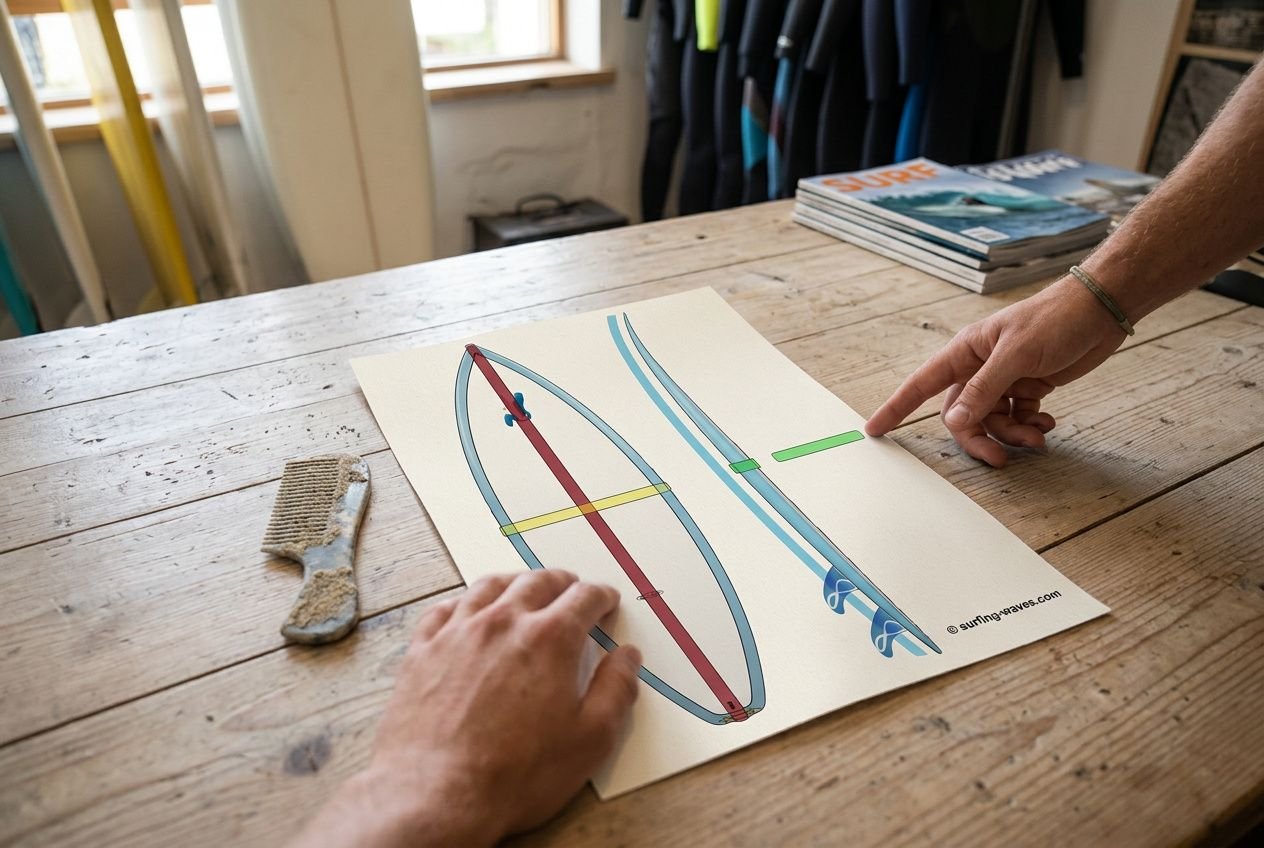
Thickness feeds directly into surfboard volume, so if you are asking how thick your surfboard should be, the cleanest starting point is your Guild Factor. Multiply your body weight in kilograms by the GF ratio that matches your level to estimate an appropriate volume in litres.
- Beginner GF: 0.40–0.50 A 70 kg beginner targets 65–75 litres; a 90 kg beginner needs 80–95 litres. That extra foam improves buoyancy and makes paddling easier from the first session.
- Intermediate GF: 0.37–0.40 The same 70 kg surfer drops to 55–65 litres once green waves are consistent. With less foam under you, the board feels more responsive and performance starts to come from cleaner rail work.
- Advanced GF: 0.34–0.36 Advanced surfers at 70 kg typically use 35–45 litres. The difference comes down to precision: buoyancy is reduced so the board reacts faster through turns.
- Frequency adjustment Surfing once a week: add about 20% to your baseline volume. Three sessions weekly: add around 5%. Four or more sessions need no adjustment.
Once the total volume is in range, distribution matters just as much as the number itself. Foam carried through the nose and centre helps a beginner with entry and stability, while volume pushed closer to the tail suits advanced surfing and a more committed approach.
How rocker, rails and nose shape influence the ride
Building on that, design details decide how the board feels under your feet. Rocker, rail profile and nose shape can change the ride completely without altering total litres.
- Rocker A flatter rocker supports easier paddling and earlier planing in weaker waves. More rocker fits steeper, hollower surf and gives a shortboard the freedom it needs in tighter pockets.
- Rails Softer, rounder rails are more forgiving and suit a beginner well. Harder rails hold better at speed, while boxier rails add float and support higher-volume boards.
- Nose shape A rounder nose keeps more foam forward and suits longboard designs or easy-entry boards. A pointed nose removes volume at the tip and gives advanced surfers a cleaner fit in critical sections.
As soon as you look at complete surfboard shapes, the logic becomes clearer. A fish usually blends flatter rocker and fuller rails for speed in small surf, while a performance shortboard pairs more curve with sharper edges for a more advanced feel and tighter response.
Worth knowing before you buy: the balance between surfboard volume, rocker, outline and rails is what separates a forgiving longboard from a reactive shortboard.
What type of surfboard suits your current skill level
Your ideal surfboard type depends on where you are right now in your board progression stages. Match the board to your current skill level, not the surfer you hope to be in six months: in practice, that choice shapes your wave count, your progress and how much fun you have each session.
Soft-top boards and longboards for beginners
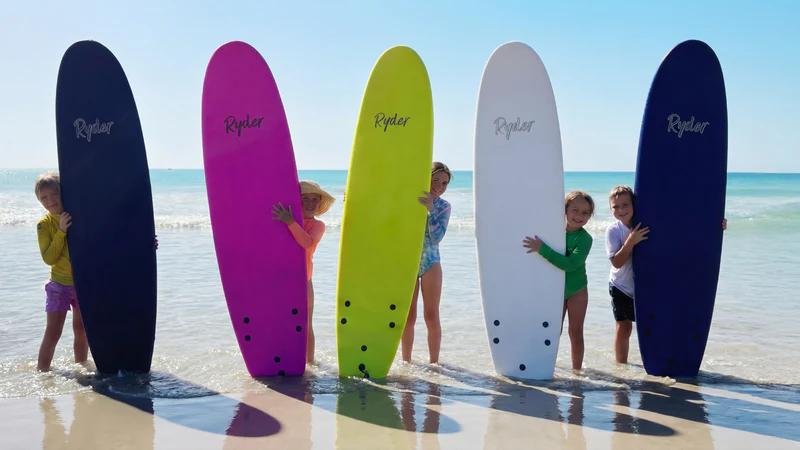
For a beginner, the most effective choice is usually one of the modern foam boards or a longboard with plenty of buoyancy. The soft-top construction pairs a polyethylene deck that softens impacts with an EPS core for lift; the harder base keeps the board stable and tracking cleanly.
A wide nose, wide tail and rounded outline create the platform you need for paddling, take-offs and first rides, while a 2+1 fin setup keeps the board predictable as control starts to build.
Mini mals, funboards and the progression path
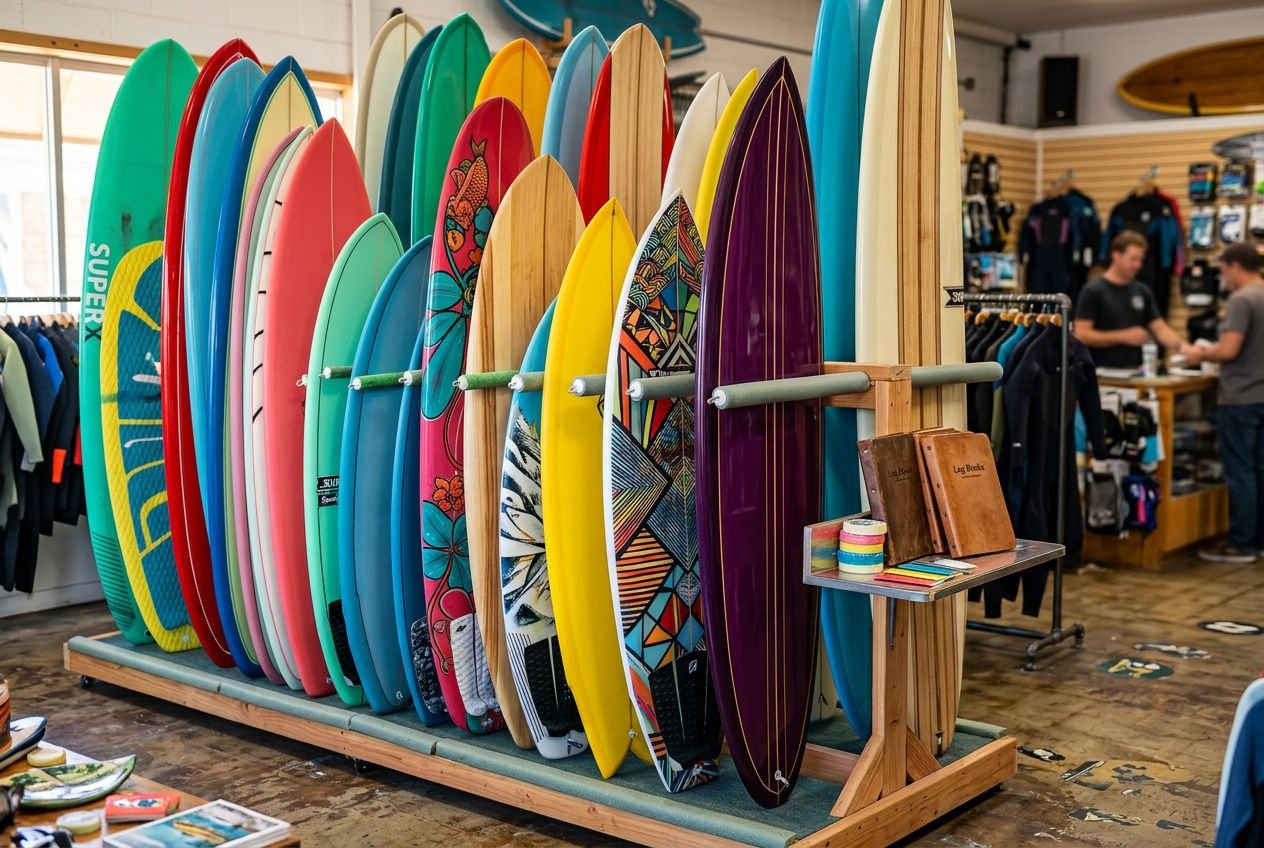
Once those basics are in place, the right choice when you start linking green-wave rides is to follow clear board progression stages. Stage 1 is a foamie or longboard, moving from whitewater to green waves; Stage 2 introduces the funboard or mini mal once basic turns begin, with a wider shortboard or groveller reserved for Stage 3.
Building on that, mini mals from 7'6" to 8'6" keep much of the easy outline of a longboard but feel noticeably less cumbersome to manoeuvre. A funboard in the 7 to 8-foot range, with 40 to 60 litres, gives many intermediate surfers around 70 to 85 kg a strong balance of buoyancy and manoeuvrability.
Fish boards and shortboards for intermediate surfers
From there, the difference comes down to how much speed and response you can create yourself. Fish boards, usually 5'4" to 6'4" with 40 to 50 litres, use a swallowtail and flatter rocker to stay quick in small to medium surf, making them a lively step once turns connect consistently.
By contrast, a shortboard in the 5'6" to 6'8" range, with 25 to 35 litres, only starts to work once your paddling is efficient, your pop-up is dependable and you can surf frontside and backside with control. Step into that surfboard type too early and performance tends to drop fast.
Surfboard construction and how it affects your choice
Two boards with the same dimensions can feel completely different once you paddle out, because the core, laminate and deck finish all affect performance, buoyancy and durability.
For a beginner, those differences show up fast: easier paddling, fewer repairs, and a board that stays stable while technique is still catching up. In practice, that matters more than brand aesthetics.
PU vs EPS construction for beginner and intermediate surfers
Most surfboard construction materials sit in two main camps: polyurethane foam with fibreglass and polyester resin, or EPS foam with epoxy resin. The difference comes down to feel, weight and how the board handles repeated use.
- PU with polyester resin: Delivers the classic flex many experienced surfers look for in rail surfing. It is heavier and more prone to dings than EPS, but the feedback is often preferred when sensitivity underfoot matters.
- EPS with epoxy resin: Lighter, more buoyant at the same size, and generally tougher against dings and delamination. It suits intermediate surfers and anyone surfing often, especially when board handling is still improving.
- Soft-top construction: Offers the highest safety margin on impact and remains the most accessible entry-level option. A soft board is still the right choice when you are a complete beginner, whatever your height, weight or fitness.
- Epoxy boards (hard): Carry more buoyancy than a comparable PU model: a 6'6" epoxy can float you like a 7'0" PU, which changes how you read size charts across brands.
Someone surfing four or more times a week will notice construction differences far more clearly than someone paddling out once.
Across all shapes, more volume usually means easier paddling, less drag and earlier wave entry. On slower waves, that extra buoyancy helps you catch more waves, and every extra take-off gives you another useful repetition as your technique develops.
When to transition from soft-top to a hard board
The move from soft board to hard board comes when you can surf green waves consistently and link smooth bottom-to-top turns on most rides, not after a fixed number of sessions.
By contrast, jumping straight onto a performance shortboard usually cuts your wave count. For most intermediate surfers, an epoxy mini mal or a wider longboard makes a better first hard board because it keeps the outline stable while adding the cleaner rail response that a soft board cannot give you.
That same logic applies if you are comparing your next step after a beginner setup. Mundo-Surf keeps real stock across longboard, shortboard and epoxy boards, with 100-day returns, so you can swap shape or size within 100 days if the first pick does not suit your level.
Frequently asked questions
What surfboard size do I need as a beginner?
For a beginner, the safest starting point is a surfboard around three feet longer than your height, then matched to your weight through surfboard volume. Up to 75 kg, look at 50–60 litres in a 7'0"–7'6" shape; 75–85 kg usually fits 60–75 litres in a 7'6"–8'0" board; above 85 kg, you will need 75+ litres at 8'0" and above.
That extra length helps with stability. Width matters too: 22 to 24 inches gives you a more stable platform for the pop-up, and in practice a soft board in that range is the right choice when your goal is early progress and easier take-offs.
That same logic applies to the board type. A soft board, foam board, funboard or longboard with enough buoyancy will help you catch waves more easily, and Mundo-Surf’s volume calculator is worth knowing before you buy if you want to check your figures before choosing.
How does surfboard volume affect performance?
It controls how high the board sits in the water, how easily you paddle, and how forgiving the board feels once you are on your feet.
That translates quickly in the line-up. Even a three-litre change is noticeable at beginner level: more volume gives you more buoyancy and a stable feel, which helps you catch waves; less volume increases rail engagement and reactivity, and the difference comes down to whether your skill level already lets you create speed without extra help from the board.
Once you want a more precise target, use the Gorilla Factor method: body weight in kilograms multiplied by your GF ratio. That benchmark clarifies your target before comparing board types: longboards and funboards at one end, performance shortboards at the other.
What surfboard type is best for my skill level?
Your skill level should decide the surfboard type, not impatience. For a beginner, a soft board or soft-top longboard with a 2+1 fin setup gives maximum stability, strong buoyancy and a forgiving shape.
As soon as you are riding green waves consistently, a mini mal or funboard in the 7'2"–8'6" range starts to add rail engagement while keeping enough volume to stay stable. Intermediate surfers usually do best here before moving on, because the board still supports progress instead of punishing small mistakes.
By contrast, advanced surfers can choose more freely. A fish works well in smaller surf, while a wider daily-driver shortboard suits more powerful waves; for advanced riders, the board that balances performance with control beats simply dropping volume too early.
Share this article: