Shopping Cart
There are no more items in your cart


Is a soft top surfboard good for beginners? A complete guide


A soft top surfboard blends a fiberglass-reinforced epoxy core with a high-density EVA deck. This construction gives new surfers a forgiving platform that makes paddling and balance significantly easier. A foam board also reduces injury risk during wipeouts while retaining enough structural integrity to hold a line.
Many surfers question whether this equipment is genuinely good for beginners or simply a short-term tool. This guide details how foam density affects your surfing and when moving to a hard surfboard becomes the right call. You will learn to recognize the difference between soft and hard surfboards before committing your money.
Soft top surfboard vs hard board: what is the difference?
A traditional hard board and a soft top share similar outlines, but the exterior materials change everything. The outer layer dictates buoyancy, impact force, and overall safety in crowded lineups. Understanding this distinction makes choosing a soft top surfboard a logical choice for beginners.
How is a soft top surfboard actually built?
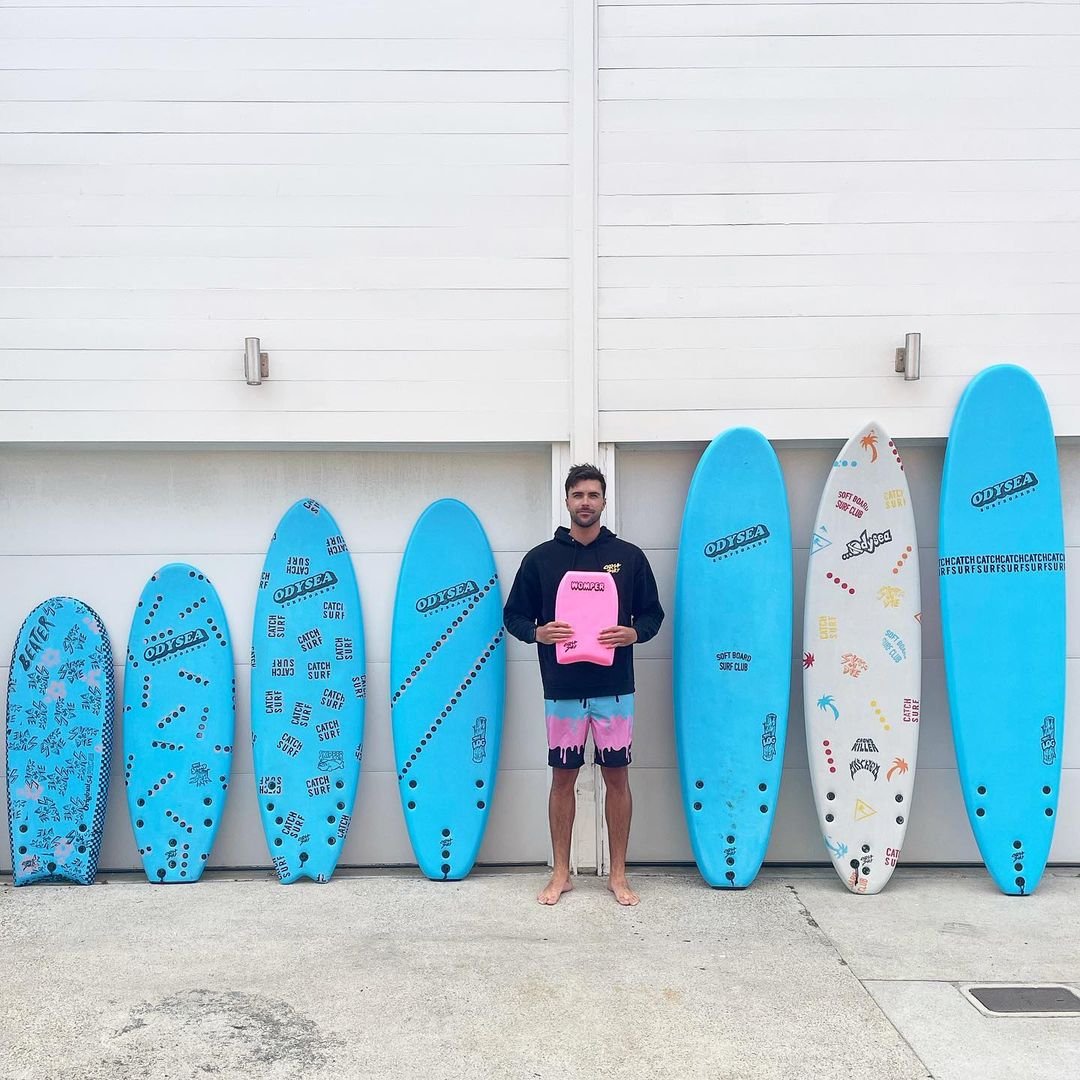
Deciding on a soft or hard top surfboard requires looking beneath the deck pad. Quality models use an EPS core reinforced with fiberglass stringers for essential stability. That rigid center is wrapped in epoxy and covered in soft foam, producing a highly stable board.
- EPS core with fiberglass stringers provides the stiffness needed to prevent the board from folding during heavy wipeouts.
- Epoxy resin coating seals the foam block against water intrusion, preventing delamination and extending the board's lifespan.
- Soft PE or EVA foam deck cushions falls and prevents sharp cuts, a crucial factor during the learning phase.
- Rubber nose and tail bumpers protect both the equipment and other surfers from blunt impact.
This hybrid build sets modern equipment apart from the flexible sponges of the past. The rigid core translates weight shifts into an immediate turning response. That internal strength makes wave catching highly efficient and supports progression for years.
Hard vs soft top: which suits your level in surfing?
A pure fiberglass board delivers rail sensitivity that rewards precise technique. A foam exterior, by contrast, removes sharp edges and reduces the consequences of poor positioning. That construction difference directly reflects your current skill level and immediate goals.
A rigid glassed board demands accurate wave-reading ability that takes seasons to develop. Greater volume and wider dimensions allow you to focus entirely on your pop-up. A stable platform accelerates learning by eliminating the constant struggle to stay upright, which is precisely why the foam board remains the standard choice for beginners in surfing.
Key physical differences that affect performance
Three structural traits separate these boards in ways you will feel immediately. These are concrete design decisions that govern paddling speed and turning radius. Recognizing them helps when choosing the correct size for your local break.
- Volume and dimensions deliver the buoyancy required to glide into waves early and paddle efficiently.
- Rail profile combines a defined lower edge with a cushioned top layer, ensuring safe contact throughout surfing.
- Nose shape features a wide surface area that prevents pearling and supports unsteady weight placement.
In practice, these specifications produce a dependable board that punishes mistakes far less severely. The soft surfboard beginners ride in surf schools relies on exactly this calculated blend of security and progression. At Mundo-Surf.com, we prioritize these hybrid constructions because they guarantee actual wave counts rather than frustration, and that is the position we hold as a guide for anyone navigating the difference between soft and hard surfboards.
Why a foamie is better than a hard board for beginners
A standard foam board delivers around 70 liters of volume, while a hard surfboard of equivalent length typically offers no more than 45. That additional volume means easier paddling, reduced injury risk, and a genuinely stable platform underfoot. That stability builds immediate confidence, and in practice, it often determines whether a beginner continues surfing or walks away from it.
Safety and buoyancy advantages of a soft top surfboard
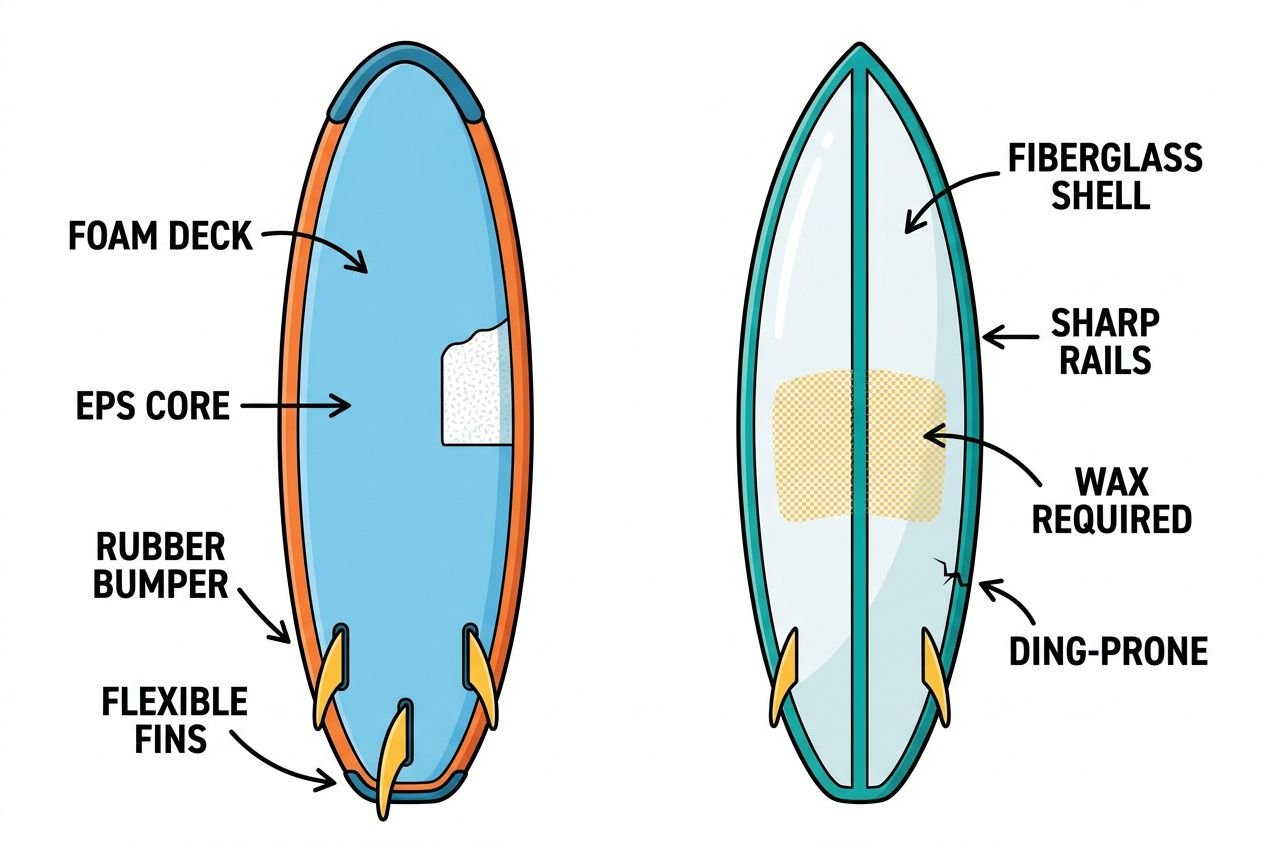
Concretely, the core difference between surfboards and foam boards comes down to impact absorption. A fiberglass rail strikes with no give whatsoever, whereas a soft top surfboard absorbs the blow. That flexible construction reduces cuts and bruises, which makes it the clear safety choice during early lessons.
- Cushioned deck impact absorption reduces bruising when you fall directly onto the board. That softer landing lowers both the physical and psychological barriers that slow early progression.
- Flexible fins bend on contact rather than cutting into skin. This removes one of the most common laceration risks during wipeouts in the whitewater.
- High buoyancy, typically between 60 and 80-plus liters of volume, supports your body weight throughout the session. Less fatigue means more consistent wave catching over time.
- Soft rails and a rounded nose limit the damage caused by collisions with other surfers. This makes a foam board the responsible choice in crowded lineups.
High volume remains the single most important factor for early progression. A board that rides high on the surface demands far less effort to match the speed of an incoming swell. That sequence, paddling, catching waves, standing, becomes repeatable on a foamie in a way it almost never does on a hard construction.
Is a soft top better than a hard top for catching waves?
The position we hold at Mundo-Surf.com is yes: the foam core generates substantial natural flotation, positioning you higher on the water and reducing the physical output required to catch waves in every session.
Frequent wave count is what actually shapes technique over time. A hard surfboard sits lower in the water and demands precise timing alongside real paddle strength. A soft top surfboard removes that steep entry requirement, replacing early frustration with an immediately higher wave count.
The inherent stability of a wide foamie gives you the extra seconds needed to execute a clean pop-up. On rigid fiberglass, any hesitation drives the rail under. On a soft top, the deck holds steady long enough to stand with control.
Cost and practical benefits of choosing a foamie
Beyond water performance, choosing a foam board makes straightforward financial sense. These boards cost considerably less upfront, they survive the inevitable impacts of learning without complaint, and they remain durable enough to hold solid resale value well into your progression.
- Lower purchase price provides a genuine entry point into surfing. You can test your commitment to the sport without committing to the cost of premium fiberglass.
- Included flexible fins eliminate a separate hardware purchase, lowering your total startup cost immediately.
- Integrated handles make the walk across the beach manageable with a large board, without needing to buy a separate transport bag.
- Durable construction holds up against knee drops and rail collisions. You avoid the costly ding repairs that accumulate quickly on fragile beginner hardboards.
At Mundo-Surf.com, fifteen years of outfitting beginners confirm that a foam board is the correct starting point. From our 6,000-product catalogue, we back that position with 100-day returns and financing across up to 18 interest-free instalments. Free shipping on orders over €99 ensures your board arrives ready for the water.
Choosing the right soft top surfboard and when to switch
A foam board loses its primary advantage—buoyancy—the moment you select a volume too low for your weight. An undersized soft top surfboard hinders progress as severely as choosing the wrong board category entirely. This guide defines precise criteria to help you make the right choice for beginners.

Soft top surfboard sizing guide by weight and age
Understanding when to transition to a hard surfboard begins with correctly sizing your current equipment. Riding a poorly sized foam surfboard for beginners eliminates the stability you need to progress. Match the size to your weight first, then adjust as your confidence in the water grows.
- Children up to 50kg (ages 10–12) require a 6'0 to 7'0 board. This longer board provides the balance young learners need while navigating a moving wave.
- Adults up to 75kg pair best with a 7'0 to 7'6 board carrying 50 to 60 liters. This range delivers reliable buoyancy for efficient paddling and pop-up mechanics.
- Adults between 75 and 85kg need a 7'6 to 8'0 softboard for beginners with 60 to 75 liters. This specific volume prevents the nose from sinking during wave entry.
- Adults weighing 85kg or more must select an 8'0 or larger board exceeding 75 liters. Anything smaller sinks under the excess weight and actively slows your progression.
A larger foamie carries more volume and increases wave-catching speed, but demands greater physical effort to turn. For most adult beginner surfers, the 7'6 range offers the most practical starting point: it stays stable underfoot while remaining manageable on the beach.
| Surfer profile | Recommended length | Volume (liters) |
| Children up to 50kg (10–12 yrs) | 6'0 – 7'0 | 35 – 50 L |
| Adults up to 75kg | 7'0 – 7'6 | 50 – 60 L |
| Adults 75 – 85kg | 7'6 – 8'0 | 60 – 75 L |
| Adults 85kg or more | 8'0 and above | 75 L and above |
When to switch to a hard top surfboard in your surfing journey
A high-quality foam board continues to serve a surfer well beyond their initial surfing lessons. Choosing to move to harder equipment makes sense once three specific skills become consistent: catching unbroken waves unassisted, executing a controlled pop-up, and initiating turns through deliberate weight shifts.
Once those fundamentals are established, a hard surfboard unlocks a level of responsiveness that foam construction cannot replicate. Critical positioning in the pocket requires a board that reacts instantly to weight transfer—and that precision only becomes a practical benefit when you are ready to demand it.
There is no fixed timeline for making this transition. Some surfers reach these markers after three months; others require a full year of surfing. The stable platform of a soft top surfboard teaches proper weight distribution, and that skill transfers directly to your next shape.
The NSP P2: a foamie built to support your progression
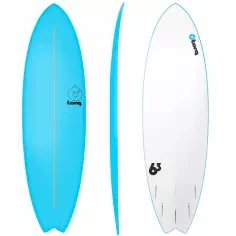
The NSP P2 Soft Surf Wide is engineered to remove the traditional compromise between safety and performance. Its EPS core incorporates fiberglass stringers for genuine structural rigidity, while rubber bumpers protect both board and surfer. It arrives complete with flexible fins, ready for immediate use.
What sets the NSP P2 apart from a basic entry-level shape is its hybrid construction. The internal rigidity improves wave-catching efficiency and makes the eventual move to a hard board feel natural rather than abrupt. For beginner surfers who want one reliable board to build confidence and balance on, this is the position we hold at Mundo-Surf.com without reservation.
Frequently asked questions
Are soft top surfboards good for beginners?
A soft top surfboard remains the ideal choice for beginners. These shapes deliver high volume and forgiving rails, which together produce the stability that early sessions demand. A foam board directly addresses the core difficulties of learning: paddling fatigue, clumsy pop-ups, and the physical risk of impact. Concretely, these qualities make soft tops consistently good for beginners across every age group.
What size soft top surfboard should a beginner choose?
The right size comes down entirely to body weight. Adults under 75 kg should look at a 7'0 to 7'6 model carrying 50 to 60 liters of volume. For surfers between 75 and 85 kg, the appropriate range shifts to a 7'6 or 8'0. Above 85 kg, you need a stable platform of at least 8'0 with a minimum of 75 liters; anything less will undermine your progress.
What are the main drawbacks of a soft top surfboard?
The primary limitation is reduced rail sensitivity relative to a hard surfboard. Excessive flex in a pure foam construction can also bleed speed, though hybrid designs address this with a hard epoxy core. In practice, you will not notice either of these drawbacks until you have genuinely outgrown your beginner board and begin attempting dynamic maneuvers on the wave face.
Recommended products

Share this article: