Shopping Cart
There are no more items in your cart


Advanced bodyboard maneuvers and transitions: expert guide


This guide breaks down how to execute and link advanced bodyboard manoeuvres and transitions, from el rollos and ARSs to inverts and backflips. You’ll get the technical detail and wave-reading logic needed to progress with confidence and consistency.
Advanced bodyboard manoeuvres and transitions
The gap between intermediate and expert wave riding rarely comes down to raw talent. What separates the two is reading what each section demands, then arriving with enough speed, commitment and body position to perform correctly. Build that foundation first; the aerials follow.
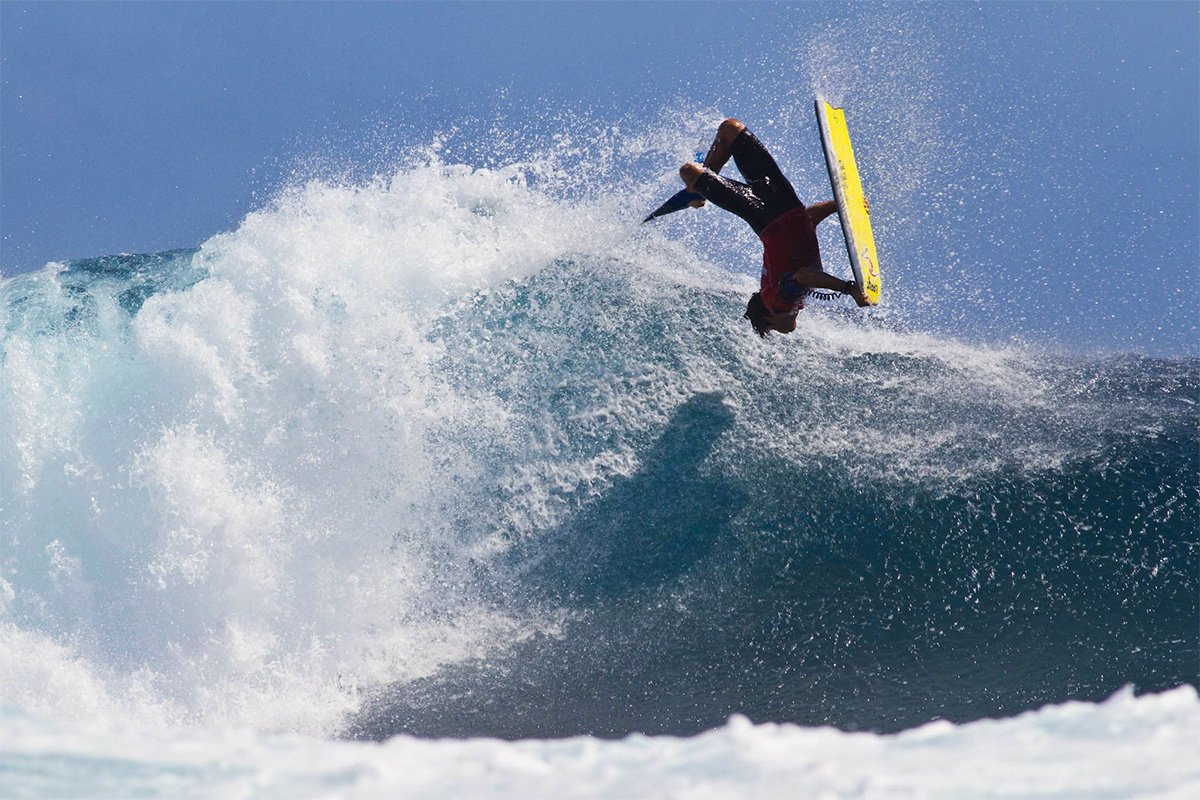
Build speed for every maneuver
Every successful aerial starts at the bottom of the wave. Your bottom turn sets the angle, rail engagement and momentum that determine whether you reach the wave lip with enough drive to become airborne. Without a committed, well-timed bottom turn, executing advanced bodyboard manoeuvres and transitions above the lip becomes guesswork.
- Rail control: engage the inside rail firmly through the bottom turn to redirect drive upwards, not across the flat. This keeps your speed focused towards the lip rather than bleeding it onto the shoulder.
- Line selection: read the wave early and identify the pitching section before take-off. A powerful, throwing wave lip is essential for an aerial, and arriving late ruins the projection.
- Body position: keep your chest low and arms forward through the ascent. Lifting too early stalls forward drive and reduces the height you can generate when the lip launches you upwards.
- Re-entry speed: re-engaging the rail cleanly after landing resets your speed for the next section. That is what separates a linked ride from a one-trick session.
In practice, the difference between a rider who links manoeuvres and one who lands a single move before stalling comes down to rail re-engagement after touchdown. As soon as your board contacts the wave face again, drive the inside rail back in and project towards the next section.
Master the El Rollo and ARS
The el rollo is the foundational aerial rotation in bodyboarding. You use the wave lip as a support point, project above it with sufficient speed, complete the rolling arc and land back on the face with control. Timing is everything: hit the lip too early and you fall behind the curtain; hit it too late and the wave swallows you. Bodyboard tricks such as double rollos, the Stone Flip and the Gyroll Air all inherit this timing, so master the single rollo before chasing combinations.
Building on that, the ARS adds a full 360-degree spin to the rollo while you remain airborne. You need momentum, a well-chosen lip section and a committed backspin at the point of projection. Perform a half roll, then spin inwards towards the wave face during the descent. The Hubb Air goes further: an air 360 followed by a roll, all in the air, and is best left to riders who already land ARSs consistently.
Control inverts and backflips
The invert sends the board above the lip with its slick facing upwards and your back towards the water, before you return to a natural position for landing. Build speed up the wave face, find a close-out section, hit the lip and launch with commitment. An inverted position in the air demands strong body control and deliberate use of the lip for projection; without both, the rotation stalls mid-air and the landing becomes unpredictable.
The backflip is a full backward somersault and one of the highest-risk manoeuvres in bodyboarding. Approach the wave lip almost vertically, rather than on the angle used for a rollo. Lift and cross both legs while airborne to drive the rotation. An incomplete flip carries a genuine injury risk, so this is the right choice when you have already logged consistent inverts and understand the section well enough to time the projection precisely.
Choose the right bodyboard setup
Your equipment directly affects your ability to execute these moves correctly. The NMD Nexus X4 supports advanced bodyboard manoeuvres and smooth transitions through its slight outline curve, which gives you greater freedom across different wave sections. Its X4 MiniQuad Concave maintains grip when you drive off the tail, then releases quickly for fast transitions between moves.
GripTech technology adds thermoformed textured zones to the deck, promoting wax build-up and improving hand grip when control matters most: mid-rotation, during a backflip or through an ARS descent. For a quad-concave alternative with similar performance focus, the Funkshen Nitro Quad bodyboard offers a different construction approach. Mundo-Surf carries both with real stock availability and 100-day returns.
| Maneuver | Difficulty | Key requirement | Core risk |
| El Rollo | Intermediate | Speed and lip timing | Missing the lip projection |
| ARS | Advanced | Momentum and backspin control | Incomplete aerial rotation |
| Invert | Advanced | Body control and close-out section | Stalled mid-air rotation |
| Backflip | Expert | Near-vertical lip hit and leg cross | Injury from incomplete flip |
| Aerial 360° | Advanced | Full airborne spin and landing | Loss of board control on descent |
Recommended products
Frequently Asked Questions
Start with your bottom turn. It needs to generate reliable speed towards the wave lip on every ride, because that is the foundation for every aerial manoeuvre. Once you reach the lip with drive to spare, practise the rollo on its own: project above the lip, commit to the arc and prioritise a clean landing over height. When you can perform the rollo consistently and re-engage your rail immediately on the face, add the 360-degree rotation that defines the ARS. Repeating the move on similar sections helps you recognise the right moment.
Consistent, controlled inverts are the minimum benchmark. If your invert still surprises you in the air, or your body position and landing remain uncertain, a backflip adds risk that practice has not prepared you to manage. The technical demand is different too: unlike a rollo or a standard invert, the backflip requires a near-vertical approach, with both legs lifted and crossed to drive the full backward rotation. You also need a wave with a powerful, throwing lip. On a weak section, the aerial manoeuvre lacks the projection the move depends on.
Yes. The difference comes down to how quickly the board grips and releases. A concave-tail design such as the X4 MiniQuad Concave holds when you drive off the tail for projection, then releases quickly for transitions between moves. That response lets a bodyboarder performing an ARS or a rollo combination link one trick to the next without losing momentum. By contrast, a board that holds instead of releasing reduces your transition speed.
GripTech textured zones improve hand control during the airborne phase, when rail grip determines whether you complete the rotation or lose it. Equipment will not replace sound technique, but the right technical setup removes friction and supports progress.
Share this article: